
IAM Factory AG at the MidPoint Community Meetup 2026
At the 2nd MidPoint Community Meetup in Prague, IAM Factory AG demonstrated how open-source IGA-as-a-Service works and took a clear stance in the cloud-versus-on-premises debate. Midway through the event, an industry announcement provided additional talking points.
Inhaltsverzeichnis
What We Brought Back from Prague
Over 200 identity experts gathered in a conference room in Prague, and not a single one was looking at their cell phone. That alone says a lot about the 2nd MidPoint Community Meetup, hosted by Evolveum from May 12 to 15.
We were there as an Evolveum partner and also contributed to the program ourselves. In his presentation “IAM Factory: Flavors of ‘as a Service’” demonstrated how midPoint can be used to implement various service models—ranging from traditional managed service delivery for end customers to platform approaches for integrators who want to use midPoint as the basis for their own solutions. At its core, the presentation addressed the question of how an open-source IGA system can meet the expectations of a true “as a Service” offering—namely, multi-tenancy, operational reliability, update cycles, and SLA compliance. These are the things that sound simple in theory but, in practice, represent the true engineering feat.
How IAM Factory AG Helped Shape the Discussion
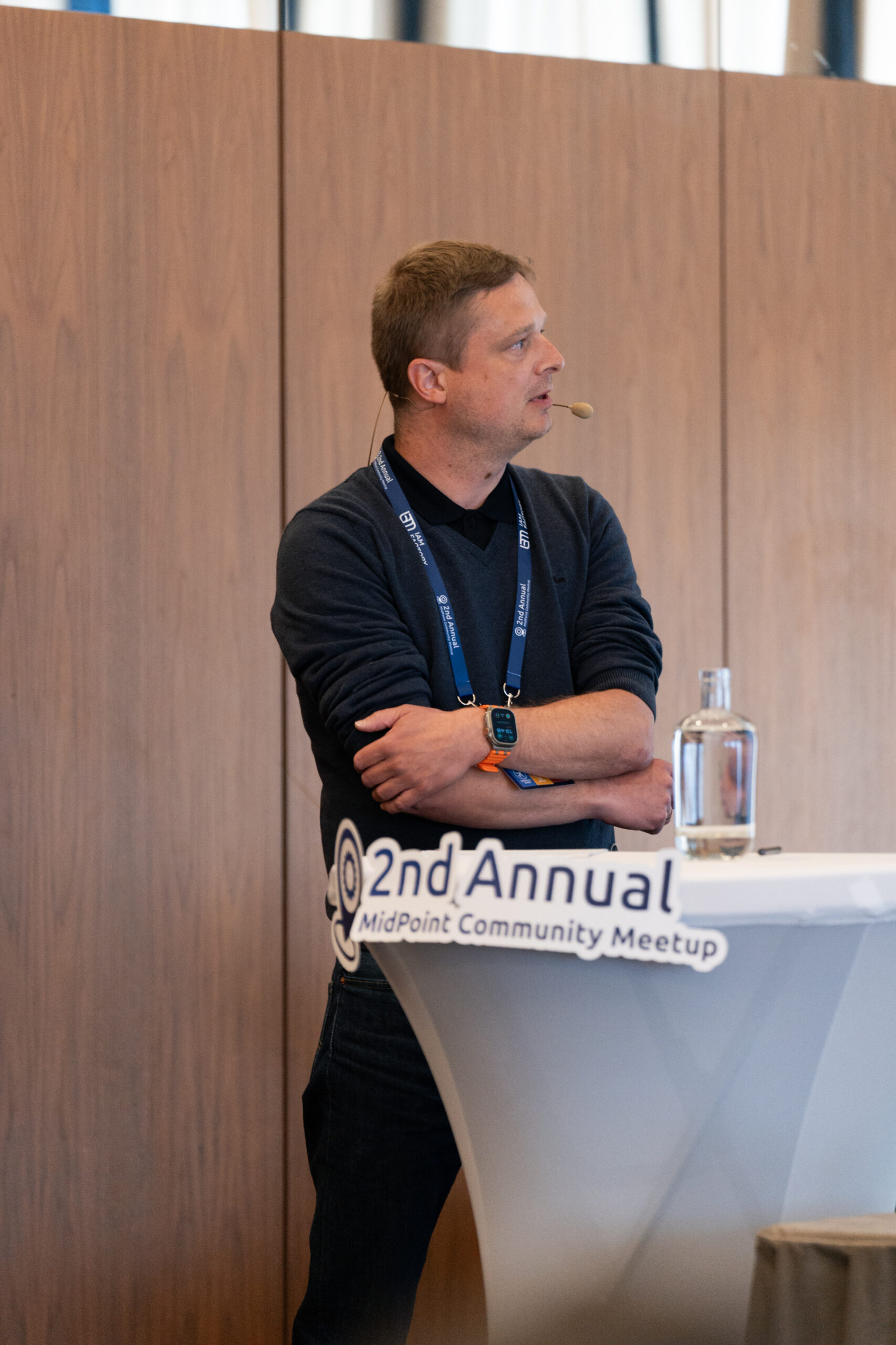
During the panel discussion “MidPoint in the Cloud or On-Premises,” Carsten took a clear pro-cloud stance, albeit with conditions that make all the difference in practice.
The most important one concerns data residency. Anyone operating in Germany or the EU must ensure that the data remains within the same jurisdiction. That sounds obvious, but it isn’t the case with many cloud services. Equally crucial is a documented exit strategy—that is, a way to return to your own infrastructure or to another cloud. Economic conditions change, and regulatory ones even more so. A cloud strategy without an exit path is not a strategy.
Another point that became clear during the discussion—because it keeps coming up as an argument—is that the cloud doesn’t save money. This is where many organizations are deceiving themselves. The benefit lies elsewhere. The cloud lowers technological barriers because organizations don’t have to operate and manage the underlying infrastructure themselves. But the provider’s SLAs must meet the organization’s own availability requirements; otherwise, you’re simply trading one problem for another.
The discussion also showed that, in practice, it is rarely a simple either/or situation. Combinations of on-premises and public cloud, private cloud and public cloud, or a purely private-cloud approach are all valid architectures. The latter, however, requires that peak loads be taken into account right from the initial design phase and that the infrastructure be scaled accordingly.
Digital sovereignty at the IAM Factory
The news that spread through the ranks
On May 13, right in the middle of the meetup, heise online reported that One Identity had laid off its German development team in Dresden. More than 40 employees, along with the development of the Identity Manager, will be relocated to Budapest. One Identity confirmed to heise that a “strategic restructuring” was taking place, without providing further details.
The announcement sparked intense discussions in Prague. Many participants know the colleagues affected; some have worked with the product for years. The question that followed was a serious one: What happens to organizations that have relied on a proprietary product whose development is suddenly shifted to another country? Who then still has access to roadmap decisions, bug fixes, and expertise?
Time and again in our projects, we find that this very dependency is the real risk factor. It’s not so much the technology or the features, but rather the question of whether we’ll still be able to talk to the people who understand the system tomorrow. Open source doesn’t solve all problems. But it fundamentally changes the balance of power.
What Remains
Four days in Prague, and much of the added value came from activities outside the official program. During breaks, at dinner, and at the cocktail reception we hosted as IAM Factory. When users, developers, and the Evolveum engineering team are all in the same room, openly discussing roadmap decisions, it creates a quality of exchange that no webinar can replace.
Let’s be honest: In our industry, there are too many events where presentations are basically just product demos in disguise. MCM2026 was the exact opposite. Practical, technically in-depth, and with a community that helps each other grow instead of just handing out business cards. We’re already looking forward to MCM2027.
If you don’t want to wait that long and are evaluating midPoint, planning a migration from a legacy system, or want to know how “as a Service” works on the basis of an open-source IGA platform, you can contact us at any time using the contact form or request a no-obligation demo.
Demo request
Experience IAM Factory in action
In a personal presentation, we will demonstrate to you
what our modular Software as a Service solution looks like in practice.
Experience modern Identity and Access Management in action and have your questions answered.